Splitting Flight Costs: Fair Settlement With a Travel Companion

Reading time: 10 minutes
You've found a great travel partner and the excitement for your shared trip is growing – but then the question comes up: who actually pays for the plane ticket? Especially in a sugar dating context or with new travel acquaintances, the question of cost becomes a tightrope walk between generosity and fair splitting. According to a study by the German Society for Consumer Studies, 63 percent of all travel partnerships run into conflicts over unclear cost agreements – especially with flight bookings.
Hidden fees, different fare classes, and spontaneous rebookings cause additional misunderstandings. Anyone who wants to split flight costs needs not only tact but also clear ground rules. This guide shows you tried-and-tested methods for transparent settlement and uncovers typical cost traps.
Why the Flight Cost Question Must Be Settled in Advance
There should be absolute clarity before booking. Nothing poisons the travel mood faster than financial misunderstandings at 35,000 feet. In classic vacation partnerships in the sugar dating model, one side often covers the flight costs entirely, while with equal travel friendships a split is common.
Communication about financial expectations should ideally take place when you first get to know each other. Many experienced frequent flyers recommend a clarifying conversation no later than 14 days before booking. Within that window, you can also still check alternative flight options.
Especially on international flights, amounts of $900 to $1,600 per person add up quickly. This creates enormous potential for conflict if expectations don't match. Define beforehand whether you'll split 50:50, one person pays for everything, or a different model is wanted.
The Three Most Common Methods for Splitting Flight Costs
In practice, three main models have become established. Each has pros and cons, depending on the nature of your travel partnership and both sides' financial means.
Fifty-Fifty Model: The Classic Split
The simplest variant works with exactly half of the costs each. One person books both tickets, and the other transfers their share in advance. This method is perfect for travel friendships between equals. The only important thing: document the total amount including all fees transparently.
With Lufthansa, for example, an economy ticket from Frankfurt to New York in September 2024 cost an average of $750, and in premium economy it was already $1,450. If you prefer the higher class but your travel partner doesn't, the difference has to be discussed individually. Does everyone pay for their own ticket, or is it split anyway?
Tools like Splitwise or Tricount help with documentation. These apps store all transactions and automatically calculate at the end who still owes whom what. Indispensable especially on multi-day trips with many individual items.
Generosity Model: One Person Pays for Everything
Common in the sugar dating context and completely legitimate: one person covers all travel costs including the flight. This variant works especially well when there's a clear income gap or when it was part of the agreement from the start.
Expectations are decisive here. Whoever pays should do so without ulterior motives or later reproaches. The receiving side, in turn, should show appreciation – for example, by organizing activities on site or small gestures during the trip.
According to a 2023 survey by the portal MissTravel, 41 percent of users in the travel companionship space prefer this model. Important: here too, state clearly before booking whether this arrangement applies and whether it covers all travel costs or only the flight.
Proportional Model Based on Income
A fair alternative for couples with different incomes: everyone pays in proportion to their salary. If one person earns twice as much as the other, they also cover two thirds of the flight costs. This method does require absolute openness about finances, though.
The calculation is simple: add both net incomes, determine each person's percentage share, and apply it to the total costs. For a $1,600 flight and an income ratio of 60:40, the higher earner pays $960 and the other person $640.
This method creates real fairness but only works with a high level of trust. Especially with new travel acquaintances, revealing your income can be uncomfortable. In that case, the other models remain the better choice.
Spotting Hidden Extra Costs on Flight Bookings
The displayed ticket price is rarely the final price. In recent years, airlines have established additional fee models that quickly cause $110 to $330 in extra costs. If you know about the hidden fees on vacation bookings, you can avoid these traps.
Baggage Fees Vary Enormously
On Ryanair, a 25-kilogram checked bag costs from about $27 per leg when booked in advance, and already $75 at the airport. EasyJet charges $41 online and $63 at the counter. These costs double for the outbound and return flights and have to be included in the overall calculation.
Some travelers deliberately book carry-on only and save $110 per person that way. Clarify beforehand whether both sides are fine with minimalist packing. For a two-week luxury Caribbean trip, carry-on alone will hardly be enough.
Seat Reservations as a Cost Trap
Sitting together costs extra – at least with most airlines. Lufthansa charges between $16 and $55 per leg and person for seat reservations in economy class, depending on flight duration and seat position. On a long-haul flight, that quickly adds up to $220 for both of you.
Decide together: is sitting together important to you, or will you save the money? Some airlines still assign seats next to each other for free at check-in if any are available. But that only works with early online check-in 24 hours before departure.
Rebooking Fees as an Underestimated Danger
Flexible tickets cost $165 to $440 more than rigid fares. With Condor, the difference between Economy Light (non-changeable) and Economy Flex (free rebooking) averages $200 per leg. If you can't yet confirm the travel dates for good, you should factor in these extra costs.
If you book inflexible tickets and the date gets shifted, rebooking fees of $275 to $550 often apply afterward. With some airlines, rebooking is even completely ruled out. This scenario regularly leads to arguments in travel partnerships when one side has to cancel at short notice.
Practical Tools for Transparent Settlement
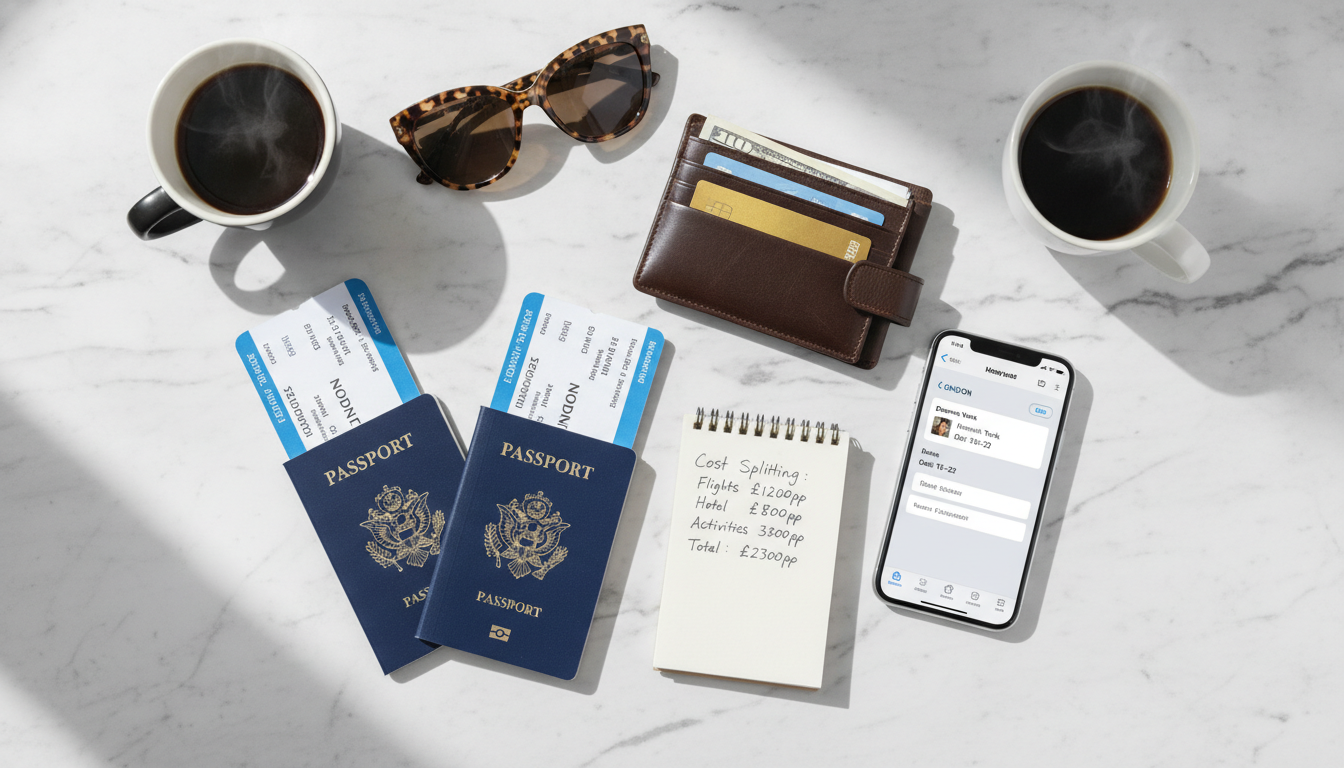
Digital helpers make cost distribution traceable and avoid arguments. These three tools have proven themselves in the travel context:
- Splitwise: Free app with currency conversion and automatic settling up. Perfect for shared trips with many individual expenses. All entries stay saved and can be exported as a PDF later.
- Revolut: Offers group accounts with a shared card. Both can make purchases, and the app shows in real time who has spent how much. Settlement happens automatically through linked personal accounts.
- PayPal Pools: You both pay an amount into a shared pool in advance, from which the plane tickets are then paid. That makes it clear from the start that both are contributing their share. Remaining amounts are refunded after the trip.
These tools build trust through transparency. Especially on your first long-haul trip together, they help avoid financial misunderstandings.
Booking Strategy: Who Should Buy the Tickets?
Not just the split but also the booking strategy affects the total costs. Whoever has loyalty programs, credit cards with travel insurance, or airline status should ideally do the booking.
Miles & More members with Senator status at Lufthansa, for example, get free baggage, lounge access, and priority boarding. These benefits partly also apply to companions on the same booking. An HON Circle Member can even bring a guest into the First Class lounge for free.
Credit cards like the American Express Platinum include travel insurance for up to two people when the flight was paid for with the card. That saves separate travel insurance worth $90 to $165. Whoever owns this card should therefore do the booking – even if the partner later transfers their share.
Tax Aspects of Travel Companionship
In a sugar dating context, covering costs can become relevant for tax purposes. If someone regularly pays high travel costs for a companion, the German tax office (Finanzamt) may classify this as a benefit in kind. According to tax advisers, the legal gray area begins at gifts of roughly $11,000 per year in Germany.
Don't worry about occasional trips: a single flight you cover isn't subject to gift tax. It only becomes relevant once regular, documentable payment flows arise. When in doubt, have it clarified with a brief consultation with a tax adviser.
Avoiding Common Mistakes When Splitting Flight Costs

From travel companions' practical experience, recurring sources of error emerge. You should know these five stumbling blocks:
First: agreeing on costs only verbally. What isn't put in writing leads to different recollections later. A short WhatsApp message with confirmation is already enough as documentation. Write, for example: "As discussed, I'll book both flights for a total of $1,340, and you'll transfer $670 to me by March 15."
Second: leaving out extras. The bare ticket price is never the final price. Include baggage, seats, and possible insurance from the start. Otherwise resentment arises later when suddenly $220 more is due.
Third: ignoring different currencies. On international flights, exchange rates fluctuate daily. Set the rate you'll convert at – ideally the rate on the booking day. Revolut shows the real-time rate without hidden markups.
Fourth: not discussing bonus points. Whoever books often collects miles or points. On a long-haul flight for two people, 8,000 miles add up quickly – worth about $130. Clarify whether these points belong to the booker or are split.
Fifth: no repayment agreement for cancellation. What happens if one person cancels at short notice? Are cancellation fees split or does the person canceling bear them alone? This question sounds uncomfortable but saves later frustration. Proper budget planning with a travel companion also covers such worst-case scenarios.
Special Cases: Business Class for One, Economy for the Other?
A delicate situation arises when there are different expectations of comfort. Can one person fly business while the other sits in economy? In the sugar dating model, that's quite common and accepted. In partnerships between equals, however, it can feel hurtful.
The price difference is considerable: a Frankfurt-Bangkok flight costs about $825 in economy and $3,750 in business class with Thai Airways. Whoever bears these extra costs of $2,900 themselves can of course upgrade. But the emotional effects should be considered.
A compromise: premium economy. On long-haul routes, this class costs about 40 to 60 percent more than economy but offers significantly more comfort. In our Bangkok example, that would be about $1,200 – a middle path both can live with.
Frequently Asked Questions About Splitting Flight Costs
How do you split flight costs fairly when one person earns significantly more?
The proportional model based on income creates real fairness. Alternatively, the financially stronger side covers the flight entirely, while the other person pays for activities or meals on site. What matters is open communication without shame about financial differences.
Which hidden costs often come up on flight bookings for two people?
The biggest cost drivers are baggage fees ($55-$155 per person), seat reservations ($33-$110 per person), credit card fees (2-3 percent on some portals), and subsequent rebookings ($275-$550). With budget airlines, these quickly add up to 30 to 40 percent of the original ticket price.
When should you take bonus points into account when splitting flight costs?
Bonus points fundamentally belong to the account holder, meaning the booker. With regular shared trips, you can agree that collected miles are used for future trips together. Alternatively, the value of the points can be deducted proportionally from the amount to be reimbursed.
What happens to shared flight costs in case of short-notice cancellation?
Ideally you've put in writing in advance who is liable for cancellation. The usual rule: whoever cancels bears the cancellation fees. In case of illness or emergencies, you split them as a goodwill gesture. Flexible tickets avoid this problem but cost more. Trip cancellation insurance for both people costs $45-$90 and covers such cases.
Should you make separate bookings or one shared ticket?
Shared bookings are usually cheaper because airlines grant group discounts. You're also more likely to sit next to each other. Downside: with rebookings or cancellations, both tickets are often affected. Separate bookings offer more flexibility but cost 5 to 15 percent more depending on the airline. For new travel acquaintances, separate bookings are recommended for maximum independence.
Conclusion: Clarity Creates a Relaxed Travel Mood
Splitting flight costs doesn't have to be a point of contention. With transparent communication, clear agreements before booking, and digital tools for documenting costs, 90 percent of all conflicts can be avoided. Consciously choose a settlement model that suits your relationship setup – whether fifty-fifty, generosity model, or proportional split.
Keep an eye on hidden fees and factor in at least a 20 to 30 percent buffer on top of the bare ticket price. If you plan ahead and think of all additional costs from the start, you'll begin your trip together relaxed. The most important rule remains: talk openly about money before you book – not only at the gate.
Use tools like Splitwise for seamless documentation and create a basis of trust for future adventures together. After all, in the end it's about travel experiences, not settlement spreadsheets. With fair cost distribution, the memory of the trip stays positive – without a bitter financial aftertaste.